DocumentClassificationMulti-agonist peptide design — scaling analysisUnimolecular polypharmacology · GPCR agonismSubjectAuthor of recordHow many receptors can one peptide target?Bogdan Dicoias · Panacea Bio ChemStatusOpen scientific description — investigational · Nothing here is medical advice
Poly-Agonism · Receptor Multiplexing · The Nona Frontier
How many receptors can one peptide target? Scaling multi-agonist design to the nine-receptor frontier
Dual agonists arrived, then triple agonists. Each new receptor arm added to a single peptide multiplies what one molecule can coordinate — and sharpens one question: how far does the architecture scale, and what governs the ceiling?
A Panacea Bio Chem technical feature · by Bogdan Dicoias, Amino-Acid-Chain (AAC) Designer
· Subject: multi-agonist (poly-agonist) peptide design ·
Programme: Nonagonist (research interest, Panacea) · Nothing here is medical advice.
Every receptor arm a peptide adds is a distinct binding pocket it must satisfy at the right strength. Scaling multi-agonist design is the discipline of doing this many times over in one sequence — the frontier Panacea Bio Chem researches through Nonagonist, by Bogdan Dicoias.
Abstract
A multi-agonist peptide is a single molecule engineered to activate several receptors at once — unimolecular polypharmacology. The metabolic field has moved from single agonists to approved dual agonists and clinical triple agonists, each added receptor arm widening the coordinated effect. This specification explains poly-agonism in plain language, sets out what actually limits how many arms one peptide can carry — the balance of relative potency, selectivity and single-molecule stability — and frames the nine-receptor (nona) idea as a design frontier for that scaling question. It closes with Nonagonist, Panacea Bio Chem's research interest in the pharmacology of balancing many receptor arms. It is a scientific description, not medical advice.
Topic: how many receptors can one peptide target |
Class: multi-agonist / poly-agonist peptide (unimolecular polypharmacology) |
Programme: Nonagonist (Panacea Bio Chem, research interest)
1. The plain idea — one peptide, many receptors
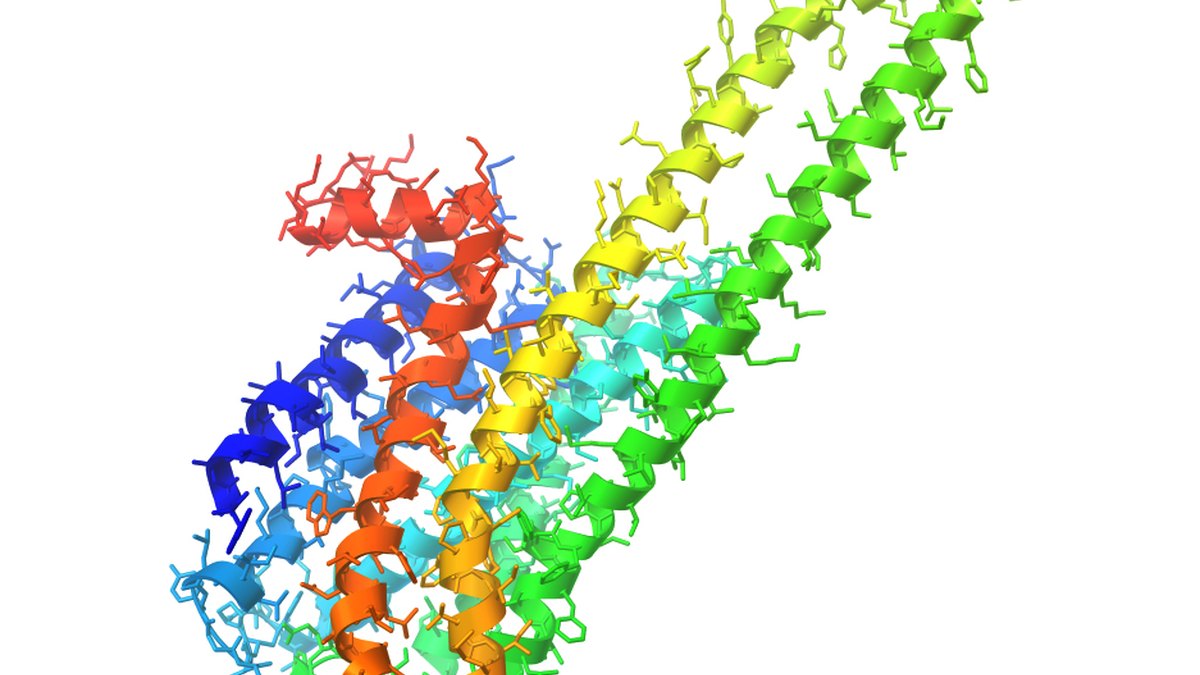
Start with the simplest picture. A receptor is a lock on the surface of a cell; a hormone is the key that fits it. Press the lock and the cell does something — releases insulin, calms an appetite circuit, tells the liver to hold its sugar. For most of pharmacology, one drug carried one key for one lock. A multi-agonist — also called a poly-agonist — is a single, cleverly shaped key cut so that it fits several locks at once. Because the multiple activities are welded into one molecule rather than mixed from several, chemists call it unimolecular polypharmacology: many pharmacologies, one molecule.1
The reason this matters is that the body rarely runs on a single signal. Metabolism, in particular, is a committee: several hormones vote at once, and the outcome depends on the balance between them. A drug that presses only one receptor is arguing with one voice in a crowded room. A well-built multi-agonist speaks to several of those receptors together, in a chosen ratio — which is why the field has spent two decades learning to fuse hormone signals into one engineered chain. The clearest example is the incretin family, where the three-receptor idea grew directly out of the
triple GLP-1 / GIP / glucagon agonist → concept.
2. The ladder so far — from one arm to three
Multi-agonism is not a leap; it is a ladder climbed one rung at a time, and every rung is real, published pharmacology. The metabolic incretin story is the best-charted example of the ascent.
The agonist ladder — receptor arms added to a single incretin-class peptide
The dual agonist tirzepatide put a GLP-1 and a GIP activity in one chain and showed the combination could do more together than either arm alone. The triple agonist retatrutide added a glucagon arm to raise energy expenditure alongside the appetite and insulin effects. Read the ladder honestly and a pattern appears: each added arm has to earn its place by contributing a complementary lever — and each one makes the design problem harder in a very specific way. Explore the individual rungs in depth on their own pages:
the four-target frontier →,
five-arm potency balance →, and
the mechanics of hitting many receptors →.
Every arm you add is a promise the molecule makes to a new receptor — and a ratio it must keep everywhere it travels.
3. What actually limits the count — the four governing constraints
"Nine receptors" sounds like a matter of ambition. It is really a matter of four intertwined engineering budgets. There is no known hard physical wall that says a peptide may address only so many receptors; the ceiling emerges from how well these four can be held together at once.
3.1 Relative potency — the balancing act
A multi-agonist is defined less by which receptors it hits than by how hard it hits each one. The therapeutic character lives in the ratio — the relative potency across arms. Shift a triple agonist toward its glucagon arm and you favour energy expenditure; shift it toward GLP-1 and you favour appetite and glucose. Every additional arm adds another dimension to this ratio that has to be dialled in deliberately, because the sequence changes that raise activity at one receptor routinely lower it at another. The design task grows faster than the arm count.
3.2 Selectivity — hitting the intended locks only
Many receptors are structural cousins — the incretin receptors belong to the same class-B GPCR family5. A key cut to fit several related locks can begin to rattle in locks it was never meant to open. Holding on-target breadth while keeping off-target activity quiet is a second budget that tightens as arms accumulate.
3.3 One molecule, one fate — sequence & stability
All of this has to live on a single peptide backbone of finite length. Each binding motif competes for the same residues and the same real estate; the more signals folded into one chain, the more the sequence is pulled in different directions — and the more delicately it must be built, folded and preserved so it survives synthesis, drying and storage as one coherent molecule.
3.4 Manufacturability — building it purely, at scale
A longer, more intricate multi-agonist is a harder peptide to synthesise cleanly and to purify. The elegance of the design means nothing if the molecule cannot be made consistently and to high purity. This is the budget that quietly decides which clever sequences ever leave the drawing board — and it is one Panacea treats as central rather than an afterthought.
4. Why balance beats a cocktail — the case for one molecule
If the aim is to engage several receptors, why not simply give several drugs together? The answer is the deepest argument for the whole field. A handful of separate drugs each has its own absorption, its own distribution and its own clearance rate — so the ratio between their effects drifts hour by hour and organ by organ. The balance you set at the syringe is not the balance the tissue receives. Fold the same activities into one molecule and they share a single half-life and a single journey: the ratio you engineered is the ratio delivered, everywhere, for as long as the molecule lasts.1 That coherence — a fixed, designed balance that travels intact — is precisely what a higher-order poly-agonist promises, and precisely what gets harder to guarantee as the arm count climbs. The reward for solving it is a molecule that behaves as a coordinated whole rather than a bag of parts. Related work explores how the quality of each arm's signalling can itself be tuned — the field of
biased agonism and signalling selectivity → — and how the whole approach sits within
rational multi-target peptide design →.
5. The real story — how three voices were fused into one
The most striking thing about multi-agonism is that its founding molecules were built from a family of hormones that are, in the body, partly opposed. GLP-1 lowers blood sugar; glucagon — its close relative, cut from the very same proglucagon precursor — raises it. For years the obvious assumption was that you would never want both in one drug. The breakthrough, credited in large part to the unimolecular-polypharmacology work of Richard DiMarchi, Matthias Tschöp and their collaborators through the 2000s and 2010s, was the realisation that glucagon's other job — increasing energy expenditure and mobilising fat — could be harnessed if its sugar-raising tendency was outvoted by a strong GLP-1 arm on the same molecule.6
Because GLP-1, GIP and glucagon all descend from related ancestral sequences, their receptors share enough shape that a single, carefully engineered peptide can be made to fit all three — a chimeric chain stitched from motifs of each. The first triple agonists were, in effect, one sentence written so that three different readers each heard their own name in it. That insight — opposed hormones made cooperative by holding their ratio inside one molecule — is the seed from which the entire scaling question grows. Every arm beyond the third is another voice added to a chord that must still resolve.
The ratio between a multi-agonist's receptor arms is not guessed; it is measured, arm by arm, in the laboratory. That patient pharmacology is the ground on which Nonagonist and Panacea Bio Chem stand, by Bogdan Dicoias.
6. Panacea Bio Chem's angle — Nonagonist
Panacea Bio Chem researches rational multi-agonist peptide design, and Nonagonist is the working name for its interest in the scaling question at the heart of this feature: how far the poly-agonist architecture can be pushed, and how the balance between many receptor arms is held. Where much of the field's difficulty now sits less in choosing receptors than in tuning the ratio between them and building the resulting molecule purely and intact, Panacea approaches a multi-agonist as a peptide it can both design and protect — treating relative-potency balance and single-molecule stability as two halves of the same problem.
The specific receptor-arm sets, ratio strategies and characterisation work behind Nonagonist are held as a proprietary Panacea Bio Chem interest, developed by Bogdan Dicoias — a biochemist and amino-acid-chain designer who works largely out of view, and whose peptide and preservation technologies have quietly drawn interest from across the pharmaceutical industry. The outline of the work is public; the exact sequences, ratios and parameters stay behind the door. What can be said plainly is the stack around it: a multi-agonist candidate would be engineered, dried and stabilised with the same tools Panacea applies to every fragile chain — the
designer-peptide craft →,
Cryolapse gentle lyophilization →,
TgShift →,
RedoxVault →, and the
S3Pulse biointegrity engine →.
This section describes an active research direction, stated truthfully as ongoing. Nothing here is a therapeutic claim, and no efficacy or outcome for Nonagonist is asserted.
7. Application fields — where scaling multi-agonism could reach furthest
Because each added receptor arm engages a distinct biological lever, higher-order poly-agonism widens the range of conditions one molecule might coordinate. Directions under active scientific investigation, offered as a map of opportunity:
Coordinated metabolism. The anchor use — the largest unmet burden is in metabolic and weight-related disease, where several hormonal levers must move together and a balanced single molecule is a natural fit.
Adding complementary axes. Beyond incretins, candidate arms such as amylin, FGF21-axis or other metabolic signals could add levers a triple agonist lacks — extending reach into liver, lipid and energy-expenditure biology.
Signalling quality, not just quantity. Pairing more arms with biased-agonism design could let a molecule choose which downstream message each receptor sends — a second axis of control layered on top of the ratio.
The build-and-protect prize. The highest-leverage challenge may be manufacturability and stability: making an intricate multi-arm peptide purely and keeping it intact from synthesiser to dose. That last mile — not the receptor choice — is the sphere Panacea researches, and where Nonagonist is aimed.
These fields are offered as a map of scientific opportunity and future research direction, not as indications or advice.
Frequently asked
How many receptors can one peptide target? Today, up to three at once in clinical practice — the triple GLP-1 / GIP / glucagon agonists; dual agonists are already approved. Four- and five-arm designs exist as research concepts. There is no known fixed limit; the practical ceiling is set by how precisely the relative potency at each arm can be tuned, kept selective, and built as one stable molecule. The nine-receptor idea frames that scaling question — it is a design frontier, not an existing medicine.
What is a multi-agonist (poly-agonist) peptide? One molecule that presses several receptors that would each ordinarily need their own drug — unimolecular polypharmacology. The incretin field leads it: hybrid peptides fuse GLP-1, GIP and glucagon activity into one chain so a single dose moves several metabolic levers together.
Why not just combine several single-target drugs? A single balanced molecule shares one half-life and one journey, so the ratio between its arms stays fixed wherever it travels. A cocktail of separate drugs drifts out of ratio as each clears at its own rate. Building the balance into one sequence is what makes a multi-agonist act as a coordinated whole.
What is Nonagonist? Nonagonist is Panacea Bio Chem's working name for its research interest in how far multi-agonist design can scale — the pharmacology of balancing many receptor arms. Panacea researches multi-target peptide design; any specific sequence or ratio work is proprietary to Bogdan Dicoias. This page is about the science of the field — nothing here is medical advice.
Trending in the field
Recent developments in the field — refreshed 2026-09-12 by Panacea Bio Chem.